-
Shop
- Adidas
- Advanced Technologies
- AI Skills Mastery 2026 Collection
- Best-Sellers
- Calvin Klein
- Car Accessories
- Confidence
- Dating & Social Skills
- Digital Resources
- AI & Technology
- AI Skills
- Beauty
- Budgeting & Saving
- Car Buying & Ownership
- Cozy Feast Collection
- Electronics & Technology
- Entrepreneurship & Business Growth
- Financial Education
- Financial Independence
- Financial Mindset & Psychology
- Goal Setting
- Hobbies
- Home Styling & Organization
- Kitchen & Recipes
- Leadership
- Mindset
- Online Business
- Parenting & Child Development
- Personal Style & Fashion
- Pet Lifestyle & Wellness
- Positive Thinking
- Sleep Improvement
- Stress Management & Relaxation
- Travel Planning
- Yoga & Fitness
- Yoga & Mind-Body Practices
- Education & Learning
- Family & Parenting
- Fashion
- Alexander McQueen
- Bags
- Bags & Wallets
- Balenciaga
- Belts
- Blazers
- Bottega Veneta
- Brunello Cucinelli
- Burberry
- Chanel
- Chloé
- Dior
- Dolce & Gabbana
- Dresses
- Etro
- Fendi
- Gucci
- Hats & Hair Accessories
- Hoodies & Sweatshirts
- Jacquemus
- Jewelry
- Jil Sander
- Keychains
- Kiton
- Luggage
- Miu Miu
- Off-White
- Prada
- Rick Owens
- Saint Laurent
- Socks & Tights
- Sweaters & Cardigans
- The Row
- Tom Ford
- Tops & Shirts
- Valentino
- Valentino Garavani
- Versace
- Vivienne Westwood
- Watches
- Furniture
- Gadgets
- Health & Beauty
- Health & Wellness
- Home & Garden
- Kids & Babies
- Kitchen
- Lighting
- Patio, Lawn & Garden
- Personal Growth
- Pet Care
- Pet Supplies
- Pets
- Shoes
- Smart Home Living Guides
- Sport & Outdoors
- Stress Relief & Relaxation
- TikTok Growth & Monetization Mastery
- Travel
- Travel & Adventure
- Wealth
- Wellness
- YouTube Shorts Best-Sellers
- Popular
- Best deals
90-Day Goal Checklist: Set Clear Milestones Fast
Why 90-day goals work when annual plans don’t stick
A full-year plan can feel inspiring in January—and invisible by March. A 90-day window is different: it’s long enough to create real results, and short enough to stay emotionally connected to the work.
- A 90-day timeframe creates urgency without the overwhelm of a full year plan.
- Progress is easier to measure: results, milestones, and habits can be reviewed weekly.
- Momentum builds faster when priorities are limited to a small set of outcomes.
- Course-correction is built in: it’s easier to adjust at week 2 than month 9.
Even the basic definition of a goal is useful here: a goal is an “end toward which effort is directed.” That “end” gets clearer when the finish line is close enough to picture. For a quick reference, the APA’s definition is a helpful grounding point: APA Dictionary of Psychology: Goal.
What the Goal-Getter Checklist helps you do
A checklist is a small tool with a big payoff: it reduces decision fatigue. Instead of repeatedly asking “What should I do next?”, you follow a simple sequence that turns a big intention into a plan you can execute on regular weekdays.
- Choose a single primary outcome for the next 90 days (with a clear “finish line”).
- Define success measures that can be tracked weekly (numbers, dates, deliverables).
- Break the goal into milestones that naturally map to weeks 1–12.
- Identify the small daily actions that make milestones inevitable.
- Spot obstacles early (time, energy, tools, skills) and plan around them.
- Build a simple review rhythm so progress doesn’t drift.
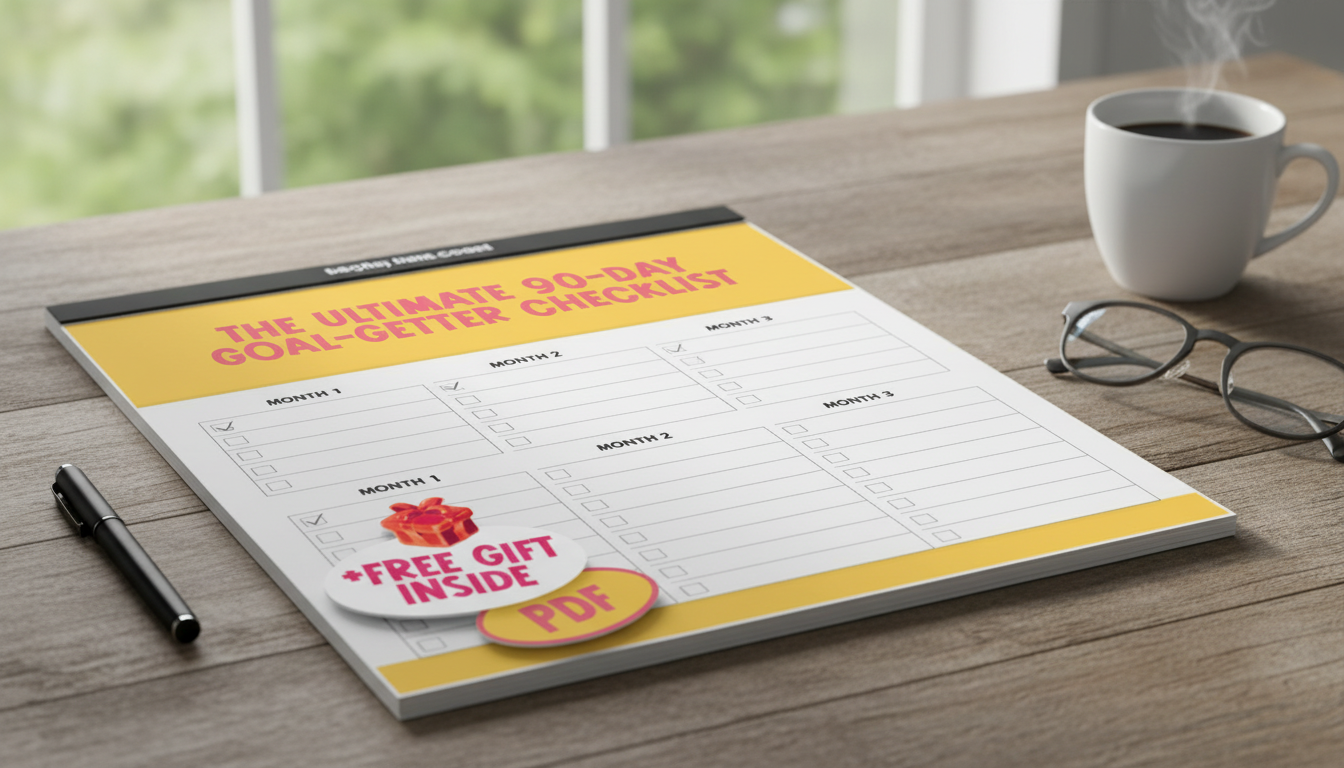
If you want a ready-to-use template, The Ultimate 90-Day Goal-Getter Checklist (digital download) is designed for either printing or filling in on-screen, so the same system can be reused each quarter.
Step-by-step: set a 90-day goal that stays clear
Clarity is the difference between “a nice idea” and a goal that survives a busy week. Use this progression to keep the outcome specific, measurable, and realistic.
- Start with an outcome statement: “In 90 days, I will ______.”
- Add a measurable target: quantity, frequency, deadline, or completion criteria.
- Confirm feasibility: time available per week, constraints, dependencies, budget.
- Decide what to stop or pause during this 90-day sprint to protect focus.
- Pick 1–3 supporting habits that make the outcome easier (sleep, planning, practice).
Quick goal clarity checklist
| Check | Question | Example |
|---|---|---|
| Outcome | What exactly is “done”? | “Publish a 20-page portfolio PDF” |
| Measure | How will progress be counted? | “Draft 2 pages/week” |
| Time | When and how often will work happen? | “Mon/Wed/Fri 30 minutes” |
| Trade-off | What will be deprioritized? | “Pause optional projects” |
| Support | What makes this easier day-to-day? | “Sunday weekly plan + daily top 3” |
Break your 90-day goal into milestones, then into weeks
Milestones are your “proof points.” They keep the goal from turning into a vague promise and give you a way to win before the final finish line. A simple rule: milestones should show visible progress, not just effort.
- Create 3–5 milestones that represent real progress (not just “stay motivated”).
- Assign milestones to rough weeks (early wins first, heavier tasks mid-sprint).
- Define a “minimum viable week” for busy periods so progress doesn’t stop entirely.
- Add a buffer week for editing, refinement, or unexpected delays.
- Make each week answer one question: “What must be true by Sunday night?”
To make weekly follow-through easier, it helps to pre-decide your “if-then” plan (also called an implementation intention): if X happens, then I will do Y. Research summaries from University College London provide a useful overview: University College London: Implementation intentions (research overview).
Turn weekly focus into daily goals that fit real life
Environment matters more than motivation. A dedicated surface for planning and a place to keep your materials visible can reduce the “setup cost” that derails daily action. If a tidy, functional setup helps, consider a practical anchor piece like the Solid Wood Coffee Table with Storage Drawers to store notebooks, pens, or a clipboard without clutter.
How to use the digital download (printable or on-screen)
If your 90-day goal includes fitness, stress management, or recovery as a supporting habit, consistency often improves when recovery is planned rather than “left over.” For an at-home routine, the Infrared Sauna for One Person can support a simple wind-down habit (for example, “Tuesday/Thursday after work”) that makes your primary goal easier to sustain.
Common goal-setting pitfalls—and how the checklist prevents them
For additional perspective on making goals effective (and avoiding the traps that make them performative instead of practical), browse the guidance collected by Harvard Business Review: Goals That Work.
Who this checklist fits best
Getting started in 20 minutes
If you want the structure already laid out, start with The Ultimate 90-Day Goal-Getter Checklist (digital download), fill it in once, then reuse the same system every quarter with a new outcome.
FAQ
How many goals should be included in a 90-day plan?
Aim for one primary outcome plus 1–3 supporting habits. Too many goals dilute time and attention; keep extra ideas in a “parking lot” list for the next 90-day cycle.
What if a week goes off track and nothing gets done?
Do a quick reset: identify what blocked progress, choose a minimum viable week, and complete one small action to regain momentum. Adjust milestones to match reality rather than quitting the goal entirely.
Is a digital checklist better than printing it?
Digital is easy to edit and reuse, while a printed page is more visible and tactile. Try one week each and keep the weekly review consistent—the review habit matters more than the format.
Recommended for you



Clear Team Goals: SMART Alignment & Weekly Scorecard
Jun 25, 2026













Leave a comment