-
Shop
- Adidas
- Advanced Technologies
- AI Skills Mastery 2026 Collection
- Best-Sellers
- Calvin Klein
- Car Accessories
- Confidence
- Dating & Social Skills
- Digital Resources
- AI & Technology
- AI Skills
- Beauty
- Budgeting & Saving
- Car Buying & Ownership
- Cozy Feast Collection
- Electronics & Technology
- Entrepreneurship & Business Growth
- Financial Education
- Financial Independence
- Financial Mindset & Psychology
- Goal Setting
- Hobbies
- Home Styling & Organization
- Kitchen & Recipes
- Leadership
- Mindset
- Online Business
- Parenting & Child Development
- Personal Style & Fashion
- Pet Lifestyle & Wellness
- Positive Thinking
- Sleep Improvement
- Stress Management & Relaxation
- Travel Planning
- Yoga & Fitness
- Yoga & Mind-Body Practices
- Education & Learning
- Family & Parenting
- Fashion
- Alexander McQueen
- Bags
- Bags & Wallets
- Balenciaga
- Belts
- Blazers
- Bottega Veneta
- Brunello Cucinelli
- Burberry
- Chanel
- Chloé
- Dior
- Dolce & Gabbana
- Dresses
- Etro
- Fendi
- Gucci
- Hats & Hair Accessories
- Hoodies & Sweatshirts
- Jacquemus
- Jewelry
- Jil Sander
- Keychains
- Kiton
- Luggage
- Miu Miu
- Off-White
- Prada
- Rick Owens
- Saint Laurent
- Socks & Tights
- Sweaters & Cardigans
- The Row
- Tom Ford
- Tops & Shirts
- Valentino
- Valentino Garavani
- Versace
- Vivienne Westwood
- Watches
- Furniture
- Gadgets
- Health & Beauty
- Health & Wellness
- Home & Garden
- Kids & Babies
- Kitchen
- Lighting
- Patio, Lawn & Garden
- Personal Growth
- Pet Care
- Pet Supplies
- Pets
- Shoes
- Smart Home Living Guides
- Sport & Outdoors
- Stress Relief & Relaxation
- TikTok Growth & Monetization Mastery
- Travel
- Travel & Adventure
- Wealth
- Wellness
- YouTube Shorts Best-Sellers
- Popular
- Best deals
1100W Meat Bandsaw: Adjustable Thickness for Portions
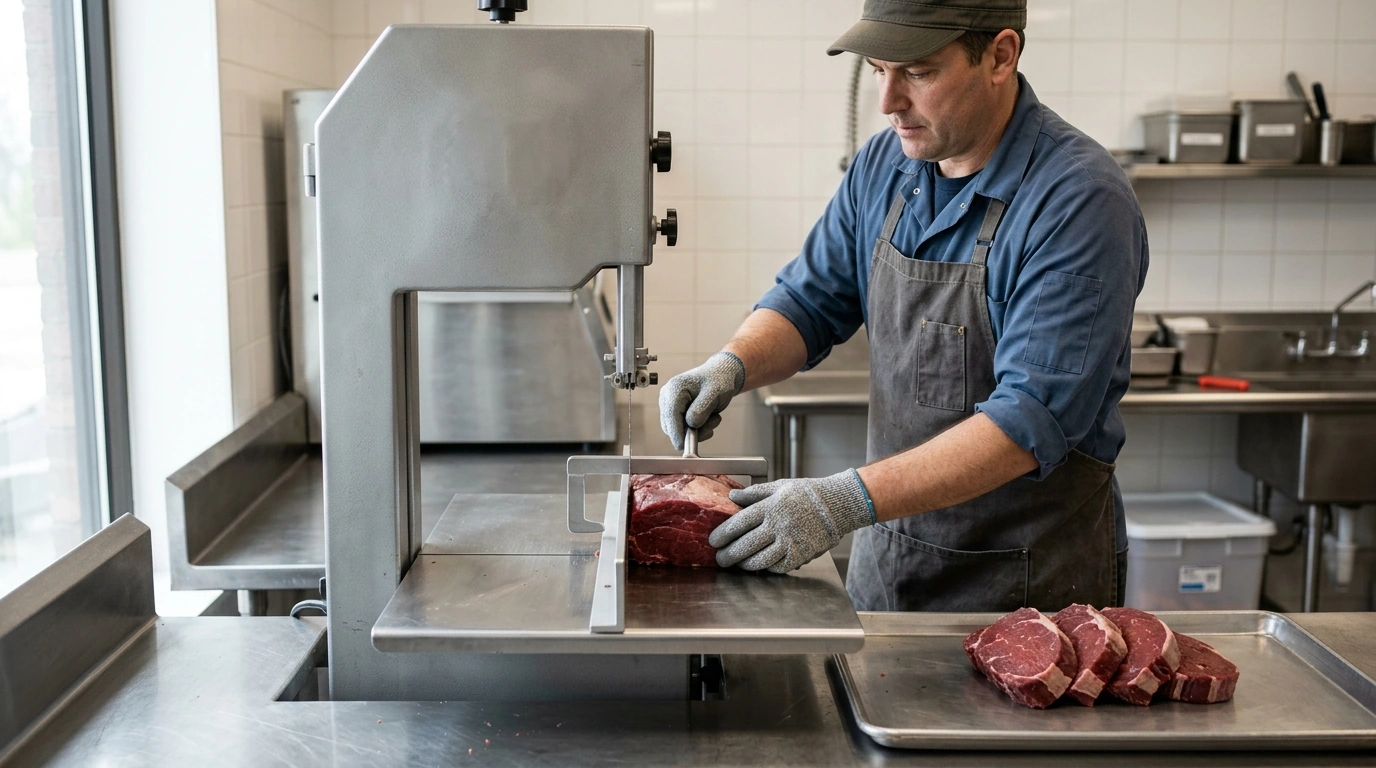
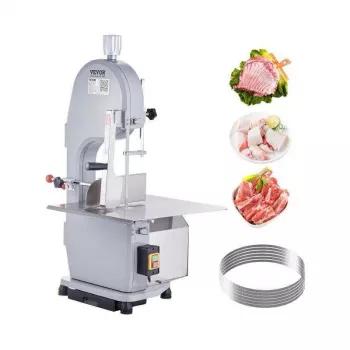
Commercial Electric Meat Bandsaw 1100W with Adjustable Cutting Thickness
When portions need to look consistent—steaks, chops, roasts, ribs, or frozen blocks—speed alone isn’t enough. A bandsaw earns its place by delivering repeatable thickness, cleaner cuts, and a steadier workflow from prep to packaging. Our team offers the Commercial Electric Meat Bandsaw 1100W with Adjustable Cutting Thickness to help you keep portions on spec, reduce waste from uneven slicing, and spend less time correcting cuts mid-shift.
Where this bandsaw fits best
If your daily work depends on predictable portion size, a bandsaw is a practical way to turn “close enough” into a repeatable standard.
- Butcher shops and meat counters: consistent steak and chop thickness for a uniform case display.
- Restaurants and catering prep: fast portioning for service-volume items while keeping cuts predictable.
- Small processors and farm shops: reliable slicing for packaged portions and customer-ready cuts.
- Frozen and semi-frozen cutting: set thickness for repeatable results when hand-sawing would be slow and uneven (follow safe handling and blade guidelines).
- Back-of-house efficiency: reduce time spent trimming and re-cutting by setting thickness once and repeating the process.
Power and control: why 1100W + adjustable thickness matters
The real payoff of a meat bandsaw is consistency at pace. Pairing an 1100W motor with adjustable cutting thickness helps you keep throughput moving without turning portioning into guesswork.
- 1100W electric drive: supports steady cutting power for faster throughput and fewer stalls during prep.
- Adjustable cutting thickness: portion control becomes a setting, not a guess—useful for cost control and consistent cook times.
- Cleaner, more uniform slices: consistent thickness supports more consistent searing, roasting, and plating results.
- Less product loss: accurate thickness helps reduce overcutting that leads to trimming and rework.
- Repeatable workflow: once thickness is dialed in, the process is easier to train and easier to maintain during rushes.
How adjustable thickness supports daily work
| Task | Thickness control helps you | Result you notice |
|---|---|---|
| Portion steaks/chops | Set a target slice width and repeat | More uniform display and pricing |
| Prep for service | Match portion thickness to cook timing | More consistent doneness across plates |
| Package retail portions | Standardize package weights and sizes | Less rework, faster packing |
| Reduce trim waste | Avoid over-slicing and correcting | Better yield over the day |
Getting consistent results: a practical cutting routine
Consistency comes from a simple routine your team can repeat, not from forcing the cut.
- Start with the target portion: decide thickness first (menu spec, retail spec, or customer request), then set the saw to match.
- Keep product stable: use steady feed pressure instead of pushing hard; letting the blade work helps keep slices straighter.
- Work in batches: cut similar shapes and temperatures together to reduce mid-batch adjustments.
- Plan for temperature: chilled product typically cuts more predictably than warm product; frozen cutting requires extra attention to safety and technique.
- Check the first cuts: confirm thickness early, then maintain the same approach through the batch.
Safety and operational best practices for a meat bandsaw
A bandsaw is a high-value tool, but it demands disciplined operation. Build habits that protect your team and keep output consistent from shift to shift.
- Machine guarding mindset: keep guards and safety features in place during operation, and stop the machine before adjustments or clearing jams.
- Blade awareness: treat the blade as a cutting zone at all times—hands stay clear, and feeding stays controlled and deliberate.
- Personal protective habits: follow your shop’s PPE and training standards (especially for cut resistance and splash management).
- Workstation discipline: keep the area dry, uncluttered, and free from loose items that could interfere with safe feeding.
- Lockout/tagout and maintenance: power down before cleaning, inspection, or blade service, and follow a documented routine to keep performance steady.
For broader safety principles, OSHA’s guidance on machine guarding is a solid reference point for powered equipment practices.
Cleaning and upkeep that protects performance
Clean equipment cuts better. Residue buildup can increase drag, affect feeding, and undermine the consistency you’re trying to achieve.
- Clean as a process, not a rush: schedule routine wipe-downs during use and a full clean at close to prevent buildup.
- Sanitation focus: manage cross-contamination risk by cleaning and sanitizing food-contact areas in line with your local requirements.
- Blade and contact areas: remove residue that can cause uneven cutting over time; consistent cleanliness supports consistent slicing.
- Inspection routine: look for wear and anything that could affect smooth feeding or thickness accuracy; address issues early to reduce downtime.
- Document the routine: a checklist keeps standards steady across shifts.
For sanitation baselines and safe handling, review USDA FSIS food safety resources and the FDA Food Code for food-contact surface guidance.
What to set up before the first shift
More in-stock picks from our team
- Commercial Electric Meat Bandsaw 1100W with Adjustable Cutting Thickness
- Instant Wall-Mounted Electric Water Heater with LCD Display
- Heart Shaped Crystal Ceiling Light
FAQ
How does adjustable cutting thickness help with portion control?
It turns portioning into a repeatable setting, which helps you keep pricing, package sizing, and cook-time consistency tighter. For best results, verify the first cuts for accuracy and keep a steady, controlled feed through the batch.
Can this bandsaw be used for cutting frozen meat?
Many shops use bandsaws for frozen or semi-frozen product because it can improve speed and repeatability versus hand-sawing. Use careful technique, keep guarding in place, and follow your food-safety and equipment procedures for blade use, handling, and sanitation.
What cleaning routine keeps a meat bandsaw cutting consistently?
Wipe down during production as needed, then complete a full clean and sanitize after use so residue doesn’t build up on contact areas. Keep an inspection habit for wear or rough feeding points, and follow your local food code and shop SOPs for sanitation frequency.
Recommended for you

Best Leather Backpacks for Women: Full, Top & Split
Oct 13, 2026













Leave a comment